
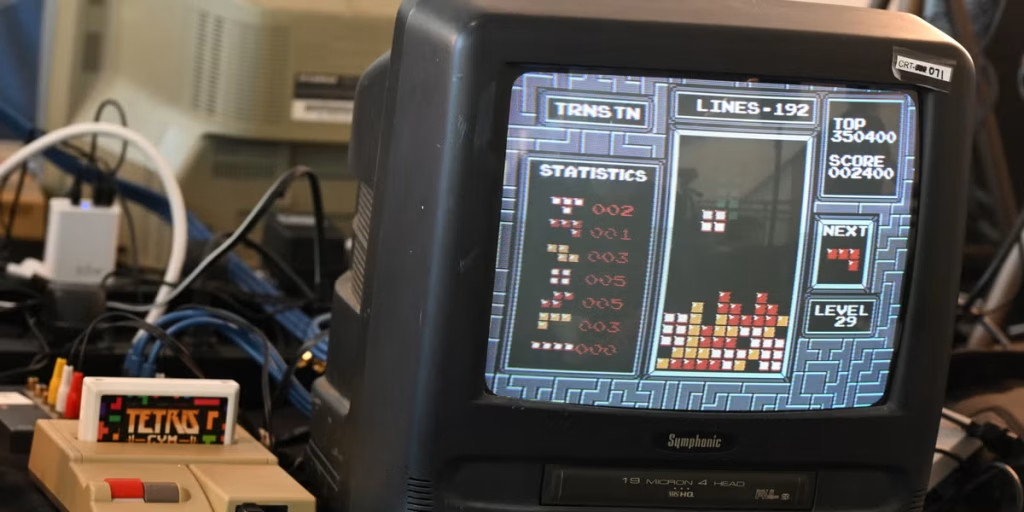
Retro gaming feels different the moment a console is connected to a CRT television. The image snaps into place in a way that flat screens struggle to replicate, and the experience immediately feels more authentic. Colors blend naturally, motion looks smoother, and games behave the way their developers expected them to. That sense of correctness is not nostalgia talking; it is rooted in how these games were originally designed and displayed.
I have spent years testing retro consoles on modern TVs with various adapters, scalers, and settings. Some setups look impressive at first glance, but something always feels slightly off. Timing issues, visual artifacts, and odd scaling quirks chip away at the experience. Going back to a CRT removes those distractions and lets the games speak for themselves.
Retro Games Were Built With CRTs in Mind
Classic consoles were designed around CRT technology from the ground up. Developers knew exactly how these displays handled resolution, color, and motion. They leaned into those characteristics, often using them creatively to enhance visuals. Sprite dithering, color blending, and transparency tricks relied on how CRTs naturally softened and merged pixels.
Modern screens display each pixel sharply and independently, exposing techniques that were never meant to be seen that way. What once looked like smooth gradients can turn into harsh checkerboard patterns. On a CRT, those same visuals appear cohesive and intentional. Playing retro games on the display type they were made for restores the original artistic vision.
Zero Input Lag Changes Everything
One of the most important advantages of CRT TVs is their lack of input lag. The signal from the console is displayed almost instantly, without the processing delays common in modern televisions. This immediacy is critical for games that rely on precise timing. Fighting games, platformers, and shooters all feel more responsive.
I notice the difference most in fast-paced titles that demand quick reactions. Jump timing feels tighter, combos execute more reliably, and movement feels directly connected to the controller. Even small amounts of lag can subtly alter gameplay, especially in games built around exact frame counts. CRTs preserve the responsiveness that these games depend on.
Motion Clarity That Flat Screens Still Struggle With
CRTs handle motion in a fundamentally different way than modern displays. Instead of holding an image on the screen until the next refresh, they redraw the image continuously. This reduces motion blur and makes fast movement look clearer. Scrolling backgrounds and rapid animations feel smoother as a result.
Many retro games rely on constant motion, whether it is a side-scrolling level or a racing track flying by. On a flat screen, that motion can smear or stutter depending on settings. CRTs maintain clarity without needing special modes or processing. The result is motion that feels natural and easy on the eyes.
Light Guns and Peripheral Compatibility
Light gun games are a perfect example of why CRTs still matter. These peripherals depend on the way CRTs scan images line by line. Modern TVs simply do not work with classic light guns without complex workarounds, if at all. Titles like Duck Hunt, Time Crisis, and House of the Dead were built entirely around CRT behavior.
Beyond light guns, other accessories also behave better on original displays. Certain rhythm games, motion-based inputs, and timing-sensitive peripherals expect zero lag and analog signal behavior. Using a CRT keeps these experiences intact without modification. It preserves entire genres that would otherwise be lost.
Aspect Ratio Without Compromise
Retro consoles output games in a 4:3 aspect ratio, which matches the shape of CRT televisions. Games were composed with this framing in mind, ensuring that characters, HUD elements, and environments fit naturally on the screen. Modern widescreen TVs often stretch or pillarbox these images, altering the intended presentation.
While settings can correct aspect ratios on flat screens, the results often feel artificial. Black bars, scaling artifacts, and uneven pixel ratios can distract from gameplay. CRTs display 4:3 content natively, without adjustments or compromises. The image simply looks right.
Analog Signals and Natural Scaling
CRTs excel at handling the analog video signals produced by older consoles. These signals vary slightly from system to system, and CRTs adapt smoothly without introducing artifacts. The image scales naturally to the screen size, maintaining consistent geometry. This flexibility is a major reason why games look so good on these displays.
Modern TVs require digital conversion, which introduces scaling challenges. Lines may appear uneven, pixels may shimmer, and edges can look harsh. Even high-quality scalers cannot fully replicate the organic look of analog display. CRTs handle these signals effortlessly because they were built for them.
Scanlines as a Visual Feature
Scanlines are often discussed as a nostalgic effect, but they serve a real visual purpose. They break up the image in a way that enhances detail and depth. Sprites appear more defined, and colors gain subtle contrast. Developers expected scanlines to be present and designed their art accordingly.
Emulated scanlines on modern TVs try to mimic this effect, but they rarely capture it accurately. The spacing, brightness, and interaction with the image differ from true CRT behavior. On an actual CRT, scanlines feel like part of the image rather than an overlay. They contribute to the overall aesthetic in a way filters cannot fully match.
Color Accuracy and Black Levels
CRTs are known for their deep blacks and vibrant colors. Because each pixel emits light directly, black areas remain truly dark. This contrast gives games a sense of depth that flat screens often struggle to reproduce. Bright colors pop without looking oversaturated or artificial.
Many retro games rely on strong contrast to define shapes and environments. Dark caves, night stages, and space backgrounds benefit from true black levels. On LCD panels, blacks can appear gray, washing out the image. CRTs maintain the visual impact these games were designed to deliver.
Durability and Longevity
CRTs were built to last. Many units from the 1980s and 1990s still function perfectly with minimal maintenance. Their components were designed for daily use over many years. This durability makes them surprisingly reliable for retro gaming setups.
I find it remarkable how well these televisions hold up over time. While modern TVs often become obsolete due to software or compatibility issues, CRTs remain consistent. Once set up, they continue to perform without updates or adjustments. That stability is refreshing in a constantly changing tech landscape.
Sound Quality and Integration
Many CRT televisions include speakers that complement retro audio well. While not high-end by modern standards, they reproduce classic game soundtracks faithfully. Chiptunes, sound effects, and synthesized music sound balanced and clear. The audio feels integrated with the visuals rather than separated.
Using external sound systems with modern setups can introduce latency or synchronization issues. CRTs keep everything in sync naturally. The simplicity of having audio and video unified in one device adds to the authenticity. It feels closer to how these games were originally experienced.
The Physical Presence of a CRT Setup
A CRT television has a physical presence that changes how gaming feels. The weight, size, and shape make it a dedicated piece of furniture rather than a disposable screen. Sitting in front of one feels intentional, like stepping into a specific gaming space. That physicality adds to the ritual of retro gaming.
Modern TVs often feel interchangeable, blending into the background. CRTs command attention and set the tone for the experience. Turning one on feels like a commitment to play. That sense of focus enhances immersion.
Why Modern Alternatives Still Fall Short
Upscalers, filters, and specialized monitors have come a long way. They can produce impressive results, especially for convenience-focused setups. However, they often require careful configuration and still miss subtle details. The experience becomes more technical than tactile.
CRTs require no menus, profiles, or firmware updates. You plug in a console and play. That simplicity removes barriers between the player and the game. It keeps the focus where it belongs.
Preserving the Original Experience
Retro gaming is not just about playing old games; it is about preserving how they were meant to be played. CRTs play a crucial role in that preservation. They maintain timing, visuals, and interaction exactly as originally intended. This accuracy matters to anyone who values gaming history.
I believe that preserving original hardware and display technology is just as important as preserving the software. Together, they form a complete experience. Separating them changes the result in subtle but meaningful ways. CRTs keep that experience whole.
Accessibility and Affordability
Despite growing interest, CRTs are still relatively affordable. Many people give them away simply to clear space. This accessibility makes it easier to build an authentic retro setup without spending a fortune. In contrast, high-end scalers and specialty displays can be expensive.
With a bit of patience, it is possible to find a great CRT locally. The value they provide often exceeds their cost. For retro gamers willing to make room, the payoff is significant. Few upgrades offer as much impact for so little investment.
Why CRTs Still Matter Today
CRTs matter because they offer something modern technology has not fully replaced. They deliver accuracy, responsiveness, and visual character that align perfectly with retro games. These qualities are not easily replicated through software or processing. They are inherent to the technology itself.
I continue to return to CRTs because they make games feel alive in a way nothing else does. They remove friction and restore intent. Retro gaming deserves that level of respect. For that reason, CRT TVs remain the best choice for anyone serious about playing classic games as they were meant to be played.