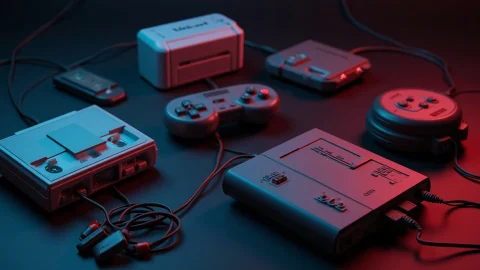

Retro gaming never confined itself to simple controllers. Consoles invited players to point plastic pistols at flickering CRT screens, stomp across vinyl pads on the living room floor, and plug strange plastic contraptions into expansion ports that few people fully understood. Those accessories expanded what games could be, even if many of them now sit in closets and storage bins, half-forgotten.
I still feel a distinct shift in mood when I swap a standard controller for something more specialized. The act of holding a light gun or rolling out a dance mat changes the posture of play. It demands movement, attention, and sometimes a willingness to look slightly ridiculous in pursuit of fun.
These devices were bold experiments in physical interaction. Some became icons of their era, while others faded quickly due to technical limits or shifting trends. Revisiting them reveals how inventive hardware designers were long before motion controls and VR headsets became industry buzzwords.
The Rise Of The Light Gun
Light guns trace their lineage back to arcade cabinets, but home versions brought that thrill into cramped living rooms. The NES Zapper stands as one of the most recognizable examples, its gray and orange shell instantly tied to Duck Hunt. Pulling the trigger and watching a pixelated duck drop felt like magic at the time.
The technology behind these devices relied on CRT displays. The gun detected changes in screen brightness during split-second flashes, translating that into hit detection. It was clever engineering that worked seamlessly under the right conditions.
That dependency on CRT screens later became a curse. Modern displays do not replicate the scanning behavior required for traditional light guns, rendering many of them unusable without specialized adapters. A whole category of hardware suddenly felt stranded in time.
Arcade Dreams At Home
Sega’s Master System Light Phaser and later the Saturn and Dreamcast light guns continued the tradition. Games like Virtua Cop turned living rooms into miniature arcades, complete with frantic reload motions and split-second reactions. I found myself standing closer to the television than recommended, fully immersed in plastic-firearm heroics.
These games delivered a different type of tension than controller-based shooters. Accuracy depended on hand stability and reflexes rather than thumb precision. The physical act of aiming added intensity to even simple enemy patterns.
Friends gathered around for multiplayer sessions that felt performative. Spectators could see missed shots and shaky hands, turning solo skill into shared spectacle.
The Weight And Feel Of Plastic Firearms
Design played a huge role in the appeal of light guns. Some were chunky and brightly colored to avoid confusion with real firearms, while others aimed for semi-realistic aesthetics. The heft of the accessory influenced immersion more than I expected.
A heavier gun sometimes made longer sessions tiring, yet it also conveyed a sense of substance. Lighter models felt toy-like but easier to wield. That balance between authenticity and comfort shaped the experience in subtle ways.
Manufacturers experimented with recoil features and alternate grips. Those additions hinted at deeper immersion, even if they rarely matched arcade cabinet quality.
Dance Mats And Rhythm Revolution
Dance mats exploded in popularity during the late 1990s and early 2000s. Dance Dance Revolution turned footwork into gameplay, translating arrow prompts into physical choreography. Rolling out a mat instantly transformed the living room into a makeshift stage.
The first time I stepped onto a dance pad, I underestimated how exhausting it would be. Within minutes, I was laughing and out of breath, chasing increasingly complex step patterns. Rhythm games became workouts disguised as entertainment.
Dance mats introduced a new kind of accessibility. Players who struggled with traditional controllers could find success through movement and timing. The physicality made gaming social in ways few other peripherals managed.
Durability And Wear
Not all dance mats were built equally. Budget versions often slid across floors or developed unresponsive arrows after heavy use. I remember taping corners down and adjusting positioning mid-song to compensate for shifting plastic.
Higher-end mats featured sturdier construction and even metal platforms. These versions better replicated arcade cabinets, though they demanded more storage space and higher budgets.
Wear and tear became part of the story. Scuffed surfaces and faded arrows told tales of countless sessions and competitive showdowns.
Forgotten Expansion Port Experiments
Many consoles featured expansion ports that inspired unusual hardware. The Sega Genesis had the Sega CD and 32X, which were ambitious add-ons that altered system capabilities. While not forgotten entirely, they occupy a strange middle ground between mainstream and niche.
Plugging additional hardware into an already complex setup felt daring. Wires multiplied, and tower-like configurations dominated entertainment centers. The visual impact alone signaled that gaming was evolving rapidly.
Not all expansions succeeded commercially, but they demonstrated a willingness to push boundaries rather than wait for entirely new console generations.
The Power Glove And Motion Control Before Its Time
The Power Glove remains one of the most infamous accessories in gaming history. Designed for the NES, it translated hand movements into on-screen actions. Its futuristic appearance promised immersion that traditional controllers could not match.
In practice, precision was inconsistent. Calibration took patience, and only a handful of games supported it properly. Still, slipping it on felt like stepping into a science fiction film.
The Power Glove’s cultural impact outlasted its practical usefulness. It symbolized ambition and the belief that motion control represented the future, even if technology had not fully caught up.
Fishing Rods, Bongos, And Specialty Controllers
Beyond guns and mats, countless specialty controllers surfaced over the years. Fishing rod peripherals for Dreamcast titles like Sega Bass Fishing mimicked casting motions with surprising effectiveness. The tactile reel added an extra layer of interaction.
Nintendo’s Donkey Konga bongos for the GameCube turned rhythm gaming into a drumming session. Tapping plastic drums in sync with music felt playful and slightly absurd, yet undeniably fun.
These accessories catered to specific games rather than broad categories. Their limited compatibility often relegated them to novelty status, but they enriched the diversity of gaming experiences.
Storage And Space Challenges
Specialized hardware introduced practical concerns. Light guns required safe storage, dance mats demanded floor space, and expansion units crowded shelves. Retro collections grow quickly when controllers extend beyond simple gamepads.
I have reorganized storage areas more than once to accommodate bulky accessories. Boxes pile up, cables tangle, and finding the right adapter becomes a scavenger hunt.
That physical presence differentiates retro gaming from digital libraries. Hardware occupies real space, making each accessory feel substantial rather than abstract.
Modern Compatibility Struggles
Technological shifts have left some peripherals stranded. Light guns tied to CRT functionality struggle on modern displays. Dance mats designed for older console ports may require converters to function with contemporary systems.
Adapters and community-made solutions attempt to bridge gaps. Enthusiasts build custom setups to preserve authentic experiences. That dedication underscores how deeply these accessories resonate.
Compatibility hurdles also highlight how quickly hardware standards evolve. What once felt cutting-edge can become obsolete within a decade.
Social Energy And Shared Spaces
Specialized hardware often thrived in group settings. Dance mats encouraged friendly competition and audience participation. Light gun games transformed cooperative play into theatrical performance.
These accessories drew people off couches and into shared physical space. Laughter, cheering, and playful teasing accompanied each session. The living room became more than a viewing area; it became an arena.
That communal spirit remains one of their greatest strengths. Standard controllers rarely replicate the same visible energy.
Why Forgotten Hardware Still Matters
Forgotten hardware tells stories about risk-taking and imagination. Companies invested in unconventional ideas, even when success was uncertain. Some accessories flopped commercially but left lasting impressions.
Exploring these devices reconnects me with an era when experimentation felt constant. Each new peripheral hinted at untapped possibilities. Even flawed designs contributed to broader innovation.
They also remind me that gaming history is not linear. Ideas resurface in new forms, refined by advancing technology. Motion tracking, VR controllers, and fitness-based games echo concepts introduced decades earlier.
Final Reflections
Light guns, dance mats, and other unusual peripherals shaped how I think about interaction in games. They expanded the vocabulary of play beyond buttons and joysticks. Physical movement, tactile feedback, and spectacle became part of the equation.
Dusting off these accessories today feels like reopening a time capsule. Some may no longer function as intended, yet their presence evokes vivid memories of crowded rooms and glowing CRT screens.
Retro gaming thrives not only on software but on the hardware experiments that accompanied it. Forgotten or not, these devices pushed boundaries and left marks that modern gaming still reflects in subtle ways.