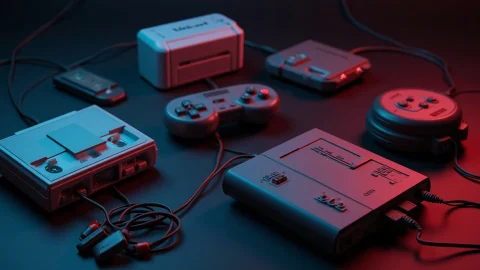

Some retro accessories feel like ambitious experiments that never quite escaped the gravity of a single title. They arrived with flashy marketing, bold promises, and oddly specific compatibility, only to become permanently tied to one cartridge or disc. I have always been fascinated by these one-game wonders because they reveal how far publishers were willing to go to sell a particular experience.
Unlike standard controllers or memory cards, these accessories were not meant to be universal tools. They were built around one concept, one gameplay mechanic, and often one major release. That narrow focus makes them strange relics today, half collectible and half curiosity, sitting on shelves as reminders of risks that did not fully pay off.
The LaserScope And Voice-Controlled Ambition
The Konami LaserScope for the NES stands as one of the boldest attempts to merge novelty with gameplay. It was a headset with a built-in microphone that allowed players to shout the word fire to shoot in certain light gun games. In practice, it was heavily associated with a single title, Laser Invasion, which was designed to showcase its capabilities.
Using the LaserScope felt futuristic at first. Strapping a headset to my head and shouting commands at the television seemed like a leap forward from pressing buttons. The novelty wore off quickly, though, because voice detection was inconsistent and background noise triggered accidental shots.
The accessory’s limited compatibility sealed its fate. Outside of its flagship game and a narrow set of light gun titles, it had little practical use. That narrow design focus turned it into a footnote in gaming history rather than a standard peripheral.
The Sega Activator And A Single Showcase
Sega’s Activator aimed to translate body movement into gameplay using infrared sensors arranged in an octagonal ring. While it technically supported multiple titles, it was deeply tied to a specific vision of motion-based fighting games. Eternal Champions was often highlighted as the experience that justified its existence.
Stepping inside the Activator ring felt like stepping into a science fiction movie. Kicking and punching in the air to control on-screen fighters was undeniably exciting at first. The problem was that responsiveness rarely matched the imagination.
Most Genesis games were not built around this kind of input. Without software designed specifically for it, the accessory struggled to find relevance. It became a symbol of ambition that outran practical execution, remembered more for its bold concept than for widespread support.
The Nintendo 64 Bio Sensor And Tetris 64
Few accessories are as specific as the Bio Sensor released in Japan for Tetris 64. This small device clipped onto the player’s ear and measured heart rate during gameplay. The idea was to adjust the game’s difficulty based on stress levels, turning a puzzle classic into a biofeedback experiment.
Playing Tetris with a heart monitor attached felt surreal. The notion that my pulse could influence falling blocks added psychological pressure to an already tense game. It transformed a familiar experience into something strangely personal.
Outside of Tetris 64, the Bio Sensor had no meaningful purpose. Its functionality was hardwired into a single cartridge, and no broader ecosystem formed around it. That exclusivity makes it one of the purest examples of an accessory built for only one game.
Steel Battalion And The Monster Controller
Capcom’s Steel Battalion for the original Xbox came packaged with a massive custom controller featuring dozens of buttons, pedals, and dual joysticks. It was not just an accessory but a command console built for one specific mech simulation. Without the game, the controller was useless.
Sitting in front of that controller felt like piloting a real machine. Each switch and lever had a designated function, and memorizing the layout became part of the challenge. The physicality elevated the experience beyond traditional gamepads.
The downside was obvious. The controller’s size and cost made it impractical for other titles, and no other game truly adopted its layout. Steel Battalion remains legendary, but the controller exists solely in its shadow, tied forever to one ambitious experiment.
The Resident Evil 4 Chainsaw Controller
Capcom revisited the idea of game-specific hardware with the Resident Evil 4 chainsaw controller. Shaped like a stylized chainsaw, it functioned as a novelty gamepad for one title. It worked, technically, but its design ensured it would never become a standard input device.
Holding a chainsaw-shaped controller during a horror game session added theatrical flair. It felt like a collector’s item meant to enhance immersion rather than improve performance. The buttons were integrated into the design, but ergonomics clearly took a back seat to aesthetics.
Beyond Resident Evil 4, the controller had no real role. Its shape made it awkward for other games, and its identity was inseparable from the title it promoted. It stands as an example of how branding can drive accessory design more than practicality.
The DK Bongos And Rhythm Exclusivity
The DK Bongos for the Nintendo GameCube are strongly associated with Donkey Konga and Donkey Kong Jungle Beat. While a few titles supported them, their identity is tightly bound to rhythm-based gameplay built specifically around bongo inputs. Without those games, the drums are little more than decorative plastic.
Tapping the bongos in time with music created a playful, physical connection to the screen. Clapping to trigger in-game actions added another layer of interaction. It felt joyful and slightly ridiculous at the same time.
Outside of compatible titles, the bongos offered limited value. Standard controllers handled most GameCube games better, and the drum interface was too specialized for broader use. Their charm lies in their narrow focus, not in versatility.
The Game Boy Printer And A Handful Of Titles
The Game Boy Printer allowed players to print small, grayscale images from compatible games. Pokémon and a select group of titles supported it, enabling the printing of Pokédex entries, certificates, or in-game photos. Its use case was specific and somewhat fleeting.
Watching a tiny strip of thermal paper emerge with a pixelated creature printed on it felt magical. It extended the game world into the physical realm in a tangible way. For a brief moment, digital accomplishments became physical souvenirs.
The printer’s relevance depended entirely on compatible cartridges. Without those specific games, it had no broader function. That tight dependency places it firmly among accessories defined by narrow software support.
Why These Accessories Fascinate Me
Game-specific accessories represent bold bets by developers and publishers. They required additional manufacturing, marketing, and shelf space, all for hardware that might only appeal to fans of one title. That level of commitment reveals confidence and, occasionally, overconfidence.
I admire the willingness to experiment, even when results were mixed. These peripherals often aimed to deepen immersion or introduce entirely new forms of interaction. Their failure to achieve widespread adoption does not erase the creativity behind them.
Collecting these items today feels like preserving alternate timelines of gaming history. Each accessory tells a story about a moment when someone believed that one game deserved its own hardware ecosystem. That belief alone makes them worth examining.
The Economics Of One-Game Hardware
Producing an accessory for a single game carries obvious risks. If the game underperforms, the hardware becomes dead stock almost immediately. Retailers are left with unsold units, and players hesitate to invest in something with such narrow use.
Limited production runs sometimes turned these accessories into future collectibles. Scarcity, combined with novelty, can drive value in the retro market. Steel Battalion controllers and Bio Sensors now attract attention precisely because they were not widely adopted.
The economic gamble behind these devices adds another layer to their story. They were not just creative risks but financial ones. That context makes them more than gimmicks; they were calculated attempts to redefine how a single title could be experienced.
Lessons From Focused Design
Designing hardware around one game allows for extreme specialization. Controls can mirror in-game mechanics perfectly, and aesthetics can align tightly with theme. The result can be a uniquely immersive experience that generic controllers cannot replicate.
The downside is inflexibility. Without broader compatibility, the accessory’s lifespan depends entirely on one game’s staying power. If interest fades, the hardware quickly becomes obsolete.
This tension between depth and versatility defines many of these accessories. They push immersion further than standard peripherals but sacrifice adaptability in the process. That trade-off remains relevant in modern gaming discussions about specialized hardware.
Final Thoughts
Accessories that only worked on one game occupy a strange and fascinating corner of retro gaming history. They embody ambition, risk, and the desire to create unforgettable experiences, even if only for a single title. Some succeeded in delivering memorable moments, while others struggled under the weight of their own novelty.
I continue to be drawn to these devices because they highlight a period when experimentation felt fearless. A game could arrive not just with a manual and a cartridge but with an entirely new way to interact. Even if their compatibility was narrow, their impact on gaming culture was anything but small.